AI vs ML vs DL: Understanding the Hierarchy
Artificial Intelligence (AI), Machine Learning (ML), and Deep Learning (DL) are often used interchangeably, but they represent distinct layers of the same hierarchy.
The Hierarchy (The Russian Doll Analogy)
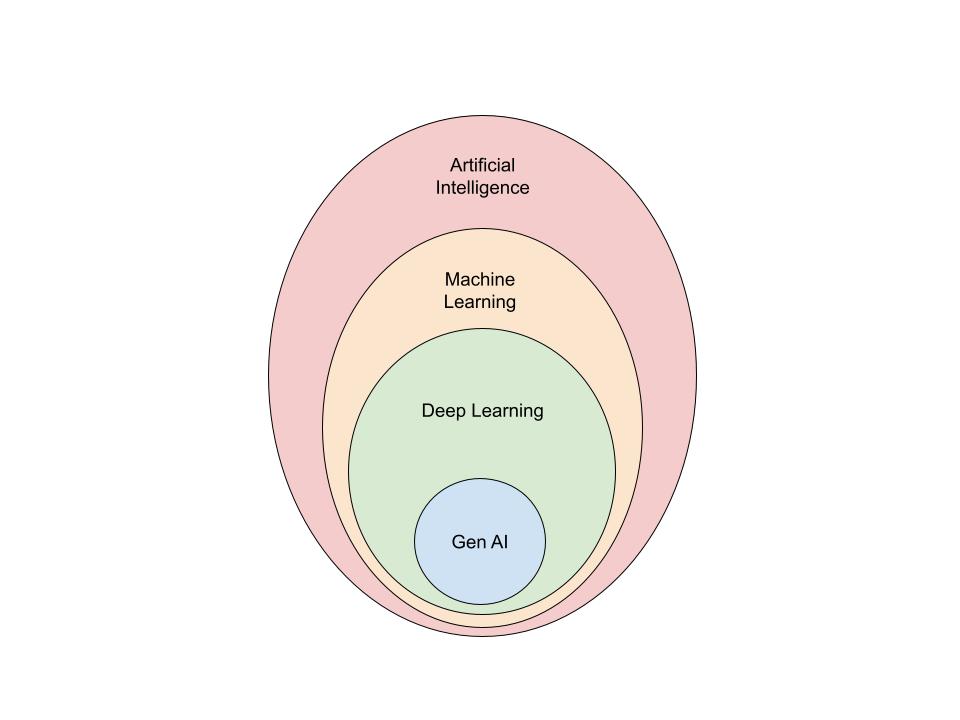
1. Artificial Intelligence (The Broad Concept)
Any technique that enables computers to mimic human intelligence. It ranges from simple “if-then” rules to complex neural networks.
- Symbolic AI: Rule-based systems.
- Narrow AI vs. General AI.
2. Machine Learning (The Subset)
A subset of AI that includes techniques that enable computers to improve at tasks with experience. Instead of hardcoded rules, the system learns patterns from data.
- Supervised Learning: Learning with labeled data.
- Unsupervised Learning: Finding hidden patterns.
3. Deep Learning (The Specialist)
A subset of ML composed of algorithms that permit software to train itself to perform tasks, like speech and image recognition, by exposing multi-layered neural networks to vast amounts of data.
- Neural Networks: Mimicking the human brain.
- Why now?: The rise of Big Data and GPU compute.
Summary Table
| Term | Definition | Example |
|---|---|---|
| AI | Programs with ability to sense, reason, act, and adapt. | Chess bot |
| ML | Algorithms whose performance improves as they are exposed to more data over time. | Spam filter |
| DL | Subset of ML in which multilayered neural networks learn from vast amounts of data. | Face recognition |